Wednesday, May 15, 2013

Lined Seahorse of Bermuda


Bermuda Post has issued  one  WWF stamp set consists of  four stamps  feature the Line Seahorse  ( Hippocampus erectus) on June 17, 2004. Along with the stamp issuance,  the First Day Cover also issued  with  the head image of the species on the left-side  and standard post mark.


img298


The lined seahorse (Hippocampus erectus), or northern seahorse or spotted seahorse is a species of fish that belongs to the Syngnathidae family. Hippocampus erectus is a diurnal species with an approximate length of 15 centimeters and lifespan of one to four years.


The Hippocampus erectus species can be found with a myriad of colors, from greys and blacks to reds, greens, and oranges. The lined seahorse lives in the Atlantic Ocean as far north as Canada and as far south as the Caribbean, Mexico, and Venezuela. It swims in an erect position and uses its dorsal and pectoral fins for guidance while swimming.

Tuesday, May 14, 2013

The Pheasant Birds of Bhutan


img297

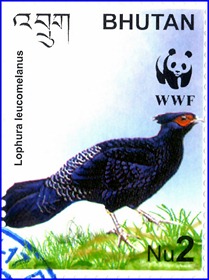
The Postal Administration of Bhutan has issued  one miniature sheet consist of four stamps WWF series feature  the pheasant bird species, Lophura leucomelanos, Tragopan blythii , Tragopan satyra  and Lophophorus impejanus  on  December 17, 2003.

img447
Lophura leucomelanos or the Kalij Pheasant, , is a pheasant found in forests and thickets, especially in the Himalayan foothills, from northern India to western Thailand. 

Males are rather variable depending on the subspecies involved, but all have an at least partially glossy bluish-black plumage, while females are overall brownish. Both sexes have a bare red face and greyish legs (the latter separating it from the red-legged Silver Pheasant).


img444
Tragopan blythii or Blyth’s Tragopan  or the Grey-bellied Tragopan is  a vulnerable species of pheasants and located in many different areas, including Bhutan through north-east India, north Myanmar to south-east Tibet, and also China.

The total population is estimated to be about 2,500 to 9,999 birds.This estimate is a very small number compared to some of its relative birds and is believed to be decreasing at a rapid rate. 


Tragopan blythii normally flocks to wooded areas as it prefers the undergrowth of evergreen oak and rhododendron forests, and other dark, quiet places. This bird has a higher elevation than most birds. Blyth’s Tragopan pheasant is the largest of the genus Tragopan.

Like most pheasants, the male is brightly colored. Females are not as brightly colored as the male tragopan, for they do not need the extravagant appearance to attract a male counterpart.

Blyth’s Tragopan are generalists. In the wild, they consume seeds, berries, fruits, and buds. Captive birds usually consume insects, worms, and even small frogs. While they are primarily vegetarians, most birds have a predilection for berries and fruit.

Monday, May 13, 2013

The Central American Wooly Opossum of Belize


img441

The Central American woolly opossum is well adapted for clambering through the treetops of its rainforest habitat. The prominent, forward-directed eyes provide the opossum with binocular vision, which enables excellent hand-eye coordination and depth perception – important in navigating through the treetops . 


img302


The Postal Administration of Belize has issued the stamp set of WWF series features the protected species  the Central American woolly opossum or Caluromys derbianus on November 01, 2004. The  another issued is one the First Day Cover that was considered  the local WWF cover. The cover have a special image of the Central American woolly opossum on the left-side of cover and  a specific post mark depicted a head of this species.

Saturday, May 11, 2013

Crested Iguana of Fiji


The Fiji crested iguana (Brachylophus vitiensis) is a critically endangered species of iguana native to some of the northwestern islands of the Fijiian archipelago, where it is found in dry forest.

img205


Fiji Post issued the local WWF of this series alongside  with the issuance of stamp set on October 27, 2010.  More explanation about the stamp set can read in  blog “Nature  Flona  Stamp “.

The Fiji crested iguana is a large stocky lizard distinguished from the Fiji banded iguana by the presence of three narrow, cream to white colored bands on males, rather than the broader bluish bands of the latter species.

The biggest threat this iguana faces is habitat loss due to fires, storms, agricultural development, and competition from feral goats.

Friday, May 10, 2013

Persian Leopard of Azerbaijan


The Postal Administration of Azerbaijan has issued the stamp set of WWF series features Persian leopard or Panthera pardus ciscaucasica  on January 07, 2005. 

The First Day Cover ( the local WWF cover) issued also along with the stamp issuance has special image of the species on the left side of cover and  also has a special post mark depicted Persian leopard.

The Persian leopard also called Caucasian leopard or Panthera pardus ciscaucasica is the largest leopard subspecies, weighing up to 90 kg , and light in color and is native to eastern Turkey, the Caucasus mountains, northern Iran, southern Turkmenistan, and parts of western Afghanistan.

img300


It is endangered throughout its range with fewer than 871–1,290 mature individuals and a declining population trend.  Persian leopards are threatened by poaching, depletion of their prey base due to poaching, human disturbance such as presence of military and training of troops in border areas, habitat loss due to deforestation, fire, agricultural expansion, overgrazing, and infrastructure development.

Recent assessments on the Persian leopard mortality rate in Iran revealed that 70% of leopard mortalities from 2007-2011 were as a result of illegal hunting or poisoning and 18% were because of road accidents

Wednesday, May 8, 2013

Jaguar of Belize


The Jaguar or Panthera onza is a big cat, a feline in the Panthera genus, and is the only Panthera species found in the Americas. The jaguar is the third-largest feline after the tiger and the lion, and the largest in the Western Hemisphere.
 
The Postal Administration of Belize has issued two of the First Day Cover along with the issuance of WWF stamp set features Jaguar or Panthera onza on December 09, 1983. One of the  WWF cover sealed with four stamp and the other one of the WWF cover sealed with a souvenir sheet. The both of local WWF cover have  a specific post mark depicted Jaguar.  
 
img303


Jaguar’s  present range extends from Mexico, through Central America and into South America, including much of Amazonian Brazil. The countries included in this range are Argentina, Belize, Bolivia, Brazil, Colombia, Costa Rica , Ecuador, French Guiana, Guatemala, Guyana, Honduras, Mexico, Nicaragua, Panama, Paraguay, Peru, Suriname, the United States and Venezuela.


This spotted cat most closely resembles the leopard physically, although it is usually larger and of sturdier build and its behavioral and habitat characteristics are closer to those of the tiger. While dense rainforest is its preferred habitat, the jaguar will range across a variety of forested and open terrains. It is strongly associated with the presence of water and is notable, along with the tiger, as a feline that enjoys swimming.

Tuesday, May 7, 2013

Ferruginous Duck of Azerbaijan


The Postal Administration of Azerbaijan has issued  the stamp set of  WWF series which  consist of four single stamps  feature  the Ferruginous Duck or Aythya nyroca on May 05, 2000. 

Along with this issuance  the local WWF cover as the First Day Cover also issued. The cover has image of this species on the left-side and special post mark depicted  Aythya nyroca.


img301


The Ferruginous Duck , also Ferruginous Pochard (Aythya nyroca) is a medium-sized diving duck from Eurasia. The species is known colloquially by birders as "Fudge Duck". It is one of the species to which the Agreement on the Conservation of African-Eurasian Migratory Waterbirds (AEWA) applies.
 

Their breeding habitat is marshes and lakes with a meter or more water depth. These ducks breed in southern and eastern Europe and southern and western Asia. They are somewhat migratory, and winter farther south and into north Africa.

Monday, May 6, 2013

Blue Lorikeet of Aitutaki


The Blue Lorikeet (Vini peruviana) is a small lorikeet from French Polynesia and the Cook Islands. They are endangered primarily by invasive species, including cats, rats, Swamp Harriers, and mosquitoes carrying avian malaria.


img296


Its plumage is mainly dark blue and it has a white area over its upper chest, throat and lower face. Erectile feathers on the top of its head show light blue streaks. Its beak is orange and its irises are yellow-brown. It has orange legs. The Blue Lorikeet has a short rounded tail. Its total length is 18 cm .

The Postal Administration of Aitutaki (Cook Islands) has issued the WWF stamp series on September 03, 2002 along with the local official First Day Cover as the local WWF cover which have standard post marked   without logo WWF.

Sunday, May 5, 2013

Endangered Wildlife of Argentina


The Postal Administration of Argentina has issued the WWF stamp set consist of four stamps depicted the endangered wildlife animal  i.e : Pudu (Pudu Puda), Chacoan peccary (Catagonus wagneri), vicuña (Vicugna vicugna), Pampas deer (Ozotoceros bezoarticus) on July 27, 2002.

Along with that issuance, the local WWF cover as the First Day Cover also issued with a  special post mark depicted Pampas deer and shown the images of Pampas deer and Pudu Puda on the left-side cover.


img293

Pudu (Pudu Puda) is one of two  Pudu species from genus Pudu. The pudus are  the world's smallest deer.  This pudu range from Southern Chile and Southwestern Argentina. PudĂşs range in size from 32 to 44 centimeters  tall, and up to 85 centimeters  long. The  other species of Pudus is Pudu mephistophiles .


img437
As of 2009, both species  of Pudus are classified as Vulnerable in the IUCN Red List, mainly because of overhunting and habitat loss. Pudu puda is listed in CITES Appendix I, and Pudu mephistophiles is listed in CITES Appendix II. 


The pudĂş is a solitary animal whose behavior in the wild is largely unknown because of its secretive nature. PudĂşs are nocturnal and diurnal, but are mostly active in the morning, late afternoon, and evening.

Their home range generally extends about 16 to 25 hectares, much of which consists of crisscrossing pudĂş-trodden paths. Each pudĂş has its own home range, or territory.

Large facial glands for scent communication allow correspondence with other pudĂş deer. PudĂşs do not interact socially, other than to mate. An easily frightened animal, the deer barks when in fear. Its fur bristles and the pudĂş shivers when angered.

Saturday, May 4, 2013

Leopard Seals of Australian-Antarctic Territory


Leopard Seal is sometimes called the sea leopard, and the resemblance is more than skin deep. Like their feline namesakes, leopard seals are fierce predators.

They are the most formidable hunters of all the seals and the only ones that feed on warm-blooded prey, such as other seals. Leopard Seal is the second largest species of seal in the Antarctic .

img295

Leopard Seals are most common in the Southern Hemisphere along the coast of Antarctica and on most sub-Antarctic islands, but can also be found on the coasts of southern Australia, Tasmania, South Africa, New Zealand, Lord Howe Island, Tierra del Fuego, the Cook Islands, and the Atlantic coast of South America.

The Australian Post has issued the WWF stamp series features this seal on September 11, 2001, along with the issuance the local WWF cover as the First Day Cover of this stamp series.

Macaca Sylvanus of Algerie


Macaca sylvanus  ( Barbary macaque) inhabits Morocco, Algeria, and Gibraltar. The majority of them are found in the Middle and High Atlas mountains and in the Rif mountain regions of Morocco.

A smaller population is located in the Tellian Atlas mountains of Algeria. Within the Atlas mountains, Macaca sylvanus is restricted to the Grand Kabylie mountains, the Petit Kabylie mountains, and the Chiffa Gorges.

The  Algerie  Post has issued  the First Day Cover  along with  the  released of WWF stamp on September 15, 1988 which features Barbary macaques on four single stamps.


img299
 

Barbary macaques prefer habitats consisting of high altitude mountains, cliffs, and gorges. Although they prefer high altitude habitats, up to 2600 m, they can also be found at sea level.

Their primary habitat is cedar forests, but they are also found in mixed forests of cedar and holm-cork oak, pure oak forests, shrubby rock outcrops along coasts, and occasionally in grasslands at low elevations. During the winter they are highly arboreal, but become more terrestrial during summer.
 

Burrowing Owl of Aruba


The Burrowing Owl (Athene cunicularia) is a tiny but long-legged owl found throughout open landscapes of North and South America. The Burrowing Owl nests in a hole in the ground. Although it is quite willing to dig its own burrow, it often uses one already provided by prairie dogs, skunks, armadillos, or tortoise.

The Postal Administration of Aruba have issued the First Day of Issue  which features the Burrowing Owl (Athene cunicularia) along with the issuance of the WWF stamp on January 28,  1994.

img294

The young are brown on the head, back, and wings with a white belly and chest. They moult into an adult-like plumage during their first summer. Burrowing Owls are comparatively easy to see because they are often active in daylight, and are surprisingly bold and approachable. The females are usually darker than the males.

Burrowing Owls are able to live for at least 9 years in the wild and over 10 years in captivity. They are often killed by vehicles when crossing roads, and have many natural enemies, including larger Owls, hawks, falcons, badgers, skunks, ferrets, armadillos, snakes, and domestic cats and dogs.
They are listed as endangered, threatened, or a species of special concern in most states and provinces where they occur.

Friday, November 16, 2012

The Giant Sea Fan of Niue - Annella mollis


The Giant Sea Fan or Annella mollis is a soft coral that found throughout Niue’s picturesque coral reef. To tribute this species, Niue Post collaborated with WWF organization released a set of four stamps, one miniature sheet, and two of official First Day Cover on September 05, 2012.

img204

The giant sea fan is a soft coral (Octocorallia) and belongs to the class of flower animals (Anthozoa). Its fans measure up to two metres and are always placed transverse to the sea current, making it easier for it to fish its food (small plankton) out of the water. Most soft corals have no true skeleton and so their bodies are flexible. Some soft corals have spikes very similar to rose thorns which may help to protect against predators.

The first of local  FDC have attached set of four single stamps and have background image of this species on the left cover. Also marked logo of WWF and has special post marks a picture of a diver exploring Niue’s waters. This unique datestamp reflecting the large number of tourists who experience Niue’s breathtaking diving environment.

Monday, October 15, 2012

Stone crayfish (Austropotamobius torrentium)

 
Slovenia Post have issued the local WWF first day cover  along with the launched the stamp series of  Stone crayfish (Austropotamobious torrentium) on September 23, 2011.   The First Day Cover has image of this species on the left-bottom side . The issued of  four  postage stamps has placed on the top rows of FDC and  cancelled with  postmark of WWF logo.

The stone crayfish is a member of the order Decapoda, or ten-legged crustaceans. Three species of crayfish live in fresh water in Slovenia: the noble crayfish, the stone crayfish and white-clawed crayfish.
 
contentimage_18111_280_0

The stone crayfish (Austropotamobius torrentium) is smaller than the noble crayfish. It grows up to 10 cm and lives primarily in small streams and also at higher elevations. It lives in streams that have mainly rocky beds, where it hides beneath the rocks. Its carapace is usually brown, and the underside of the claws is lighter and never red as are those of the noble crayfish. Its range extends throughout central and southern Europe.

In Slovenia it is widespread mainly in the Sava and Drava watersheds, and is less present in the Primorska and Pomurje regions. Due to its small size it was never very interesting economically and was never bred or used as a food source.  
Due to the regulation of watercourses and water pollution, all of these crayfish species are highly threatened and therefore also protected. Natura 2000 protection areas have been established in order to protect the stone crayfish.


Saturday, June 2, 2012

Fiji’s Tuna Today and for the Future

 
fiji's tuna

Fiji Post have collaborated with WWF organization issued the stamp set feature Fiji’s tuna, in related with the concern topic of Fiji government regarding to their population for today and the future, on April 07, 2004. The species of tuna are depicted are skipjack tuna, yellowfin tuna, bigeye tuna,  and albacore. The issues are presented in one miniature sheet consist of 4  single stamps and local first day cover that have background image of tuna fishes in the sea with logo of WWF and motto “ Fiji’s Tuna Today and for the Future” as reminder for every one to care this species.

Wednesday, May 2, 2012

Iceland – 50th Anniversary of WWF Organization

img659
In the year 2011,  World Wide Fund for Nature have  celebrated the 50th anniversary. Iceland Post commemorated this  anniversary by issued the special stamp features endangered birds. The officially FDC also issued together with stamp. On the FDC have marked logo of WWF and noticed the 50th anniversary. A comprehensive survey of endangered birds was first issued in the year 2000 listing 32 bird species which account for 42% of all Icelandic breeding birds. Not all these species are in immediate danger of extinction.

Thursday, February 23, 2012

Butterflies of Ireland - 2005

img702

Ireland Post  has issued the local FDC  together the stamp set featuring the species of butterflies , Small Copper / Lycaena phlaeas, Green Hairstreak / Callophrys rubi , Pearl-bordered Fritillary / Boloria euphrosyne , and Painted Lady on May 24, 2005. The issue stamps have designed by Ian Loe Artwork, consist of 4 single postage stamps and one souvenir sheet. Maxi cards also issued  and depicted each species in more detail.

Wednesday, February 22, 2012

Cay Van ( Owston's Banded Civets )- Vietnam 2005

img689

Vietnam Post together with WWF organization issued  stamp set features the rare species, Owston’s palm civet or Chrotogale owstoni on  May 2, 2005. The issue presented in 4 postage stamps and one souvenir sheet . Along with this issuance,  Vietnam Post also released 2 (two) local FDC which depicted the species on the left-side  and a special cancellation mark.

Tuesday, February 21, 2012

Orchid flower of Suriname–Special Issued 1986.

rare orchid

This stamp series are special issue by Suriname Post and WWF organization  on 19 February 1998. The Local FDC issued by Suriname Post on the same date. The species depicted on stamps are epidendrum ciliare, epidendrum vespa, epidendrum anceps, cyenoches chlorochilon, meanwhile the species of epidendrum ciliare drawn  on  the left side of fdc. A special post mark have shape of orchid flower.

Monday, February 20, 2012

Rare fauna II–Jersey 2004

img706

Jersey Post collaborated with WWF organization  issued the second series of  the rare fauna ( threatened species) on July 27, 2004.The depicted species are Wall Lizard / Podarcis muralis , Ant Lion / Eurolean nostras , Field Cricket / Gryllus campestris, and Dartford Warbler / Sylvia undata. Along with the issue stamp,  Jersey Post released also the local FDC and maxi cards. The local FDC  have marked  image of Dartford Warbler on the left side and a special post mark shown Dartford Warbler also. Meanwhile maxi card  presented more detail of each species and each card have attached stamp of the related species.
Related Posts Plugin for WordPress, Blogger...