Showing posts with label 2002. Show all posts

Monday, May 6, 2013

Blue Lorikeet of Aitutaki


The Blue Lorikeet (Vini peruviana) is a small lorikeet from French Polynesia and the Cook Islands. They are endangered primarily by invasive species, including cats, rats, Swamp Harriers, and mosquitoes carrying avian malaria.


img296


Its plumage is mainly dark blue and it has a white area over its upper chest, throat and lower face. Erectile feathers on the top of its head show light blue streaks. Its beak is orange and its irises are yellow-brown. It has orange legs. The Blue Lorikeet has a short rounded tail. Its total length is 18 cm .

The Postal Administration of Aitutaki (Cook Islands) has issued the WWF stamp series on September 03, 2002 along with the local official First Day Cover as the local WWF cover which have standard post marked   without logo WWF.

Sunday, May 5, 2013

Endangered Wildlife of Argentina


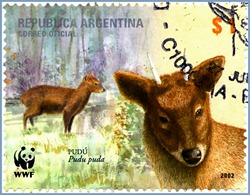
The Postal Administration of Argentina has issued the WWF stamp set consist of four stamps depicted the endangered wildlife animal  i.e : Pudu (Pudu Puda), Chacoan peccary (Catagonus wagneri), vicuña (Vicugna vicugna), Pampas deer (Ozotoceros bezoarticus) on July 27, 2002.

Along with that issuance, the local WWF cover as the First Day Cover also issued with a  special post mark depicted Pampas deer and shown the images of Pampas deer and Pudu Puda on the left-side cover.


img293

Pudu (Pudu Puda) is one of two  Pudu species from genus Pudu. The pudus are  the world's smallest deer.  This pudu range from Southern Chile and Southwestern Argentina. Pudús range in size from 32 to 44 centimeters  tall, and up to 85 centimeters  long. The  other species of Pudus is Pudu mephistophiles .

img437
As of 2009, both species  of Pudus are classified as Vulnerable in the IUCN Red List, mainly because of overhunting and habitat loss. Pudu puda is listed in CITES Appendix I, and Pudu mephistophiles is listed in CITES Appendix II. 


The pudú is a solitary animal whose behavior in the wild is largely unknown because of its secretive nature. Pudús are nocturnal and diurnal, but are mostly active in the morning, late afternoon, and evening.

Their home range generally extends about 16 to 25 hectares, much of which consists of crisscrossing pudú-trodden paths. Each pudú has its own home range, or territory.

Large facial glands for scent communication allow correspondence with other pudú deer. Pudús do not interact socially, other than to mate. An easily frightened animal, the deer barks when in fear. Its fur bristles and the pudú shivers when angered.

Saturday, December 10, 2011

The European Turtle Dove – Portugal 2002


The Madeira Post, Portugal, has collaborated with WWF Organisation to issue  the stamp series depict The European Turtle Dove (Streptopelia turtur) on August 30, 2002. The official first day cover also issued as the local WWF cover which depicts this bird and a specific postmark which drawn the two european turtle dove.

img712

The European Turtle Dove (Streptopelia turtur), also known as Turtle Dove, is a member of the bird family Columbidae, which includes the doves and pigeons.the European Turtle Dove may be recognised by its browner colour, and the black-and-white-striped patch on the side of its neck. The tail is notable as the bird flies from the observer; it is wedge shaped, with a dark centre and white borders and tips. Smaller and slighter in build than many other doves, it measures 24–29 cm  in length, 47–55 cm  in wingspan and weighs 85–170 g .

Tuesday, November 8, 2011

Leopard Snake (Elaphe Situla) - Ukraine 2002

WWF-FDC Ukraine 2004


On 25 May 2002 Ukraine Post issued the local WWF cover as official FDC of the WWF stamp series. The cover has specific postmark and depict the Elaphe situla on the left bottom corner.
Related Posts Plugin for WordPress, Blogger...