Monday, May 6, 2013

Blue Lorikeet of Aitutaki


The Blue Lorikeet (Vini peruviana) is a small lorikeet from French Polynesia and the Cook Islands. They are endangered primarily by invasive species, including cats, rats, Swamp Harriers, and mosquitoes carrying avian malaria.


img296


Its plumage is mainly dark blue and it has a white area over its upper chest, throat and lower face. Erectile feathers on the top of its head show light blue streaks. Its beak is orange and its irises are yellow-brown. It has orange legs. The Blue Lorikeet has a short rounded tail. Its total length is 18 cm .

The Postal Administration of Aitutaki (Cook Islands) has issued the WWF stamp series on September 03, 2002 along with the local official First Day Cover as the local WWF cover which have standard post marked   without logo WWF.

Sunday, May 5, 2013

Endangered Wildlife of Argentina


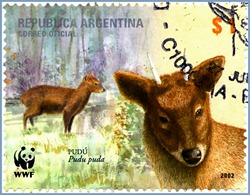
The Postal Administration of Argentina has issued the WWF stamp set consist of four stamps depicted the endangered wildlife animal  i.e : Pudu (Pudu Puda), Chacoan peccary (Catagonus wagneri), vicuña (Vicugna vicugna), Pampas deer (Ozotoceros bezoarticus) on July 27, 2002.

Along with that issuance, the local WWF cover as the First Day Cover also issued with a  special post mark depicted Pampas deer and shown the images of Pampas deer and Pudu Puda on the left-side cover.


img293

Pudu (Pudu Puda) is one of two  Pudu species from genus Pudu. The pudus are  the world's smallest deer.  This pudu range from Southern Chile and Southwestern Argentina. Pudús range in size from 32 to 44 centimeters  tall, and up to 85 centimeters  long. The  other species of Pudus is Pudu mephistophiles .

img437
As of 2009, both species  of Pudus are classified as Vulnerable in the IUCN Red List, mainly because of overhunting and habitat loss. Pudu puda is listed in CITES Appendix I, and Pudu mephistophiles is listed in CITES Appendix II. 


The pudú is a solitary animal whose behavior in the wild is largely unknown because of its secretive nature. Pudús are nocturnal and diurnal, but are mostly active in the morning, late afternoon, and evening.

Their home range generally extends about 16 to 25 hectares, much of which consists of crisscrossing pudú-trodden paths. Each pudú has its own home range, or territory.

Large facial glands for scent communication allow correspondence with other pudú deer. Pudús do not interact socially, other than to mate. An easily frightened animal, the deer barks when in fear. Its fur bristles and the pudú shivers when angered.

Saturday, May 4, 2013

Leopard Seals of Australian-Antarctic Territory


Leopard Seal is sometimes called the sea leopard, and the resemblance is more than skin deep. Like their feline namesakes, leopard seals are fierce predators.

They are the most formidable hunters of all the seals and the only ones that feed on warm-blooded prey, such as other seals. Leopard Seal is the second largest species of seal in the Antarctic .

img295

Leopard Seals are most common in the Southern Hemisphere along the coast of Antarctica and on most sub-Antarctic islands, but can also be found on the coasts of southern Australia, Tasmania, South Africa, New Zealand, Lord Howe Island, Tierra del Fuego, the Cook Islands, and the Atlantic coast of South America.

The Australian Post has issued the WWF stamp series features this seal on September 11, 2001, along with the issuance the local WWF cover as the First Day Cover of this stamp series.

Macaca Sylvanus of Algerie


Macaca sylvanus  ( Barbary macaque) inhabits Morocco, Algeria, and Gibraltar. The majority of them are found in the Middle and High Atlas mountains and in the Rif mountain regions of Morocco.

A smaller population is located in the Tellian Atlas mountains of Algeria. Within the Atlas mountains, Macaca sylvanus is restricted to the Grand Kabylie mountains, the Petit Kabylie mountains, and the Chiffa Gorges.

The  Algerie  Post has issued  the First Day Cover  along with  the  released of WWF stamp on September 15, 1988 which features Barbary macaques on four single stamps.


img299
 

Barbary macaques prefer habitats consisting of high altitude mountains, cliffs, and gorges. Although they prefer high altitude habitats, up to 2600 m, they can also be found at sea level.

Their primary habitat is cedar forests, but they are also found in mixed forests of cedar and holm-cork oak, pure oak forests, shrubby rock outcrops along coasts, and occasionally in grasslands at low elevations. During the winter they are highly arboreal, but become more terrestrial during summer.
 

Burrowing Owl of Aruba


The Burrowing Owl (Athene cunicularia) is a tiny but long-legged owl found throughout open landscapes of North and South America. The Burrowing Owl nests in a hole in the ground. Although it is quite willing to dig its own burrow, it often uses one already provided by prairie dogs, skunks, armadillos, or tortoise.

The Postal Administration of Aruba have issued the First Day of Issue  which features the Burrowing Owl (Athene cunicularia) along with the issuance of the WWF stamp on January 28,  1994.

img294

The young are brown on the head, back, and wings with a white belly and chest. They moult into an adult-like plumage during their first summer. Burrowing Owls are comparatively easy to see because they are often active in daylight, and are surprisingly bold and approachable. The females are usually darker than the males.

Burrowing Owls are able to live for at least 9 years in the wild and over 10 years in captivity. They are often killed by vehicles when crossing roads, and have many natural enemies, including larger Owls, hawks, falcons, badgers, skunks, ferrets, armadillos, snakes, and domestic cats and dogs.
They are listed as endangered, threatened, or a species of special concern in most states and provinces where they occur.

Friday, November 16, 2012

The Giant Sea Fan of Niue - Annella mollis


The Giant Sea Fan or Annella mollis is a soft coral that found throughout Niue’s picturesque coral reef. To tribute this species, Niue Post collaborated with WWF organization released a set of four stamps, one miniature sheet, and two of official First Day Cover on September 05, 2012.

img204

The giant sea fan is a soft coral (Octocorallia) and belongs to the class of flower animals (Anthozoa). Its fans measure up to two metres and are always placed transverse to the sea current, making it easier for it to fish its food (small plankton) out of the water. Most soft corals have no true skeleton and so their bodies are flexible. Some soft corals have spikes very similar to rose thorns which may help to protect against predators.

The first of local  FDC have attached set of four single stamps and have background image of this species on the left cover. Also marked logo of WWF and has special post marks a picture of a diver exploring Niue’s waters. This unique datestamp reflecting the large number of tourists who experience Niue’s breathtaking diving environment.

Monday, October 15, 2012

Stone crayfish (Austropotamobius torrentium)

 
Slovenia Post have issued the local WWF first day cover  along with the launched the stamp series of  Stone crayfish (Austropotamobious torrentium) on September 23, 2011.   The First Day Cover has image of this species on the left-bottom side . The issued of  four  postage stamps has placed on the top rows of FDC and  cancelled with  postmark of WWF logo.

The stone crayfish is a member of the order Decapoda, or ten-legged crustaceans. Three species of crayfish live in fresh water in Slovenia: the noble crayfish, the stone crayfish and white-clawed crayfish.
 
contentimage_18111_280_0

The stone crayfish (Austropotamobius torrentium) is smaller than the noble crayfish. It grows up to 10 cm and lives primarily in small streams and also at higher elevations. It lives in streams that have mainly rocky beds, where it hides beneath the rocks. Its carapace is usually brown, and the underside of the claws is lighter and never red as are those of the noble crayfish. Its range extends throughout central and southern Europe.

In Slovenia it is widespread mainly in the Sava and Drava watersheds, and is less present in the Primorska and Pomurje regions. Due to its small size it was never very interesting economically and was never bred or used as a food source.  
Due to the regulation of watercourses and water pollution, all of these crayfish species are highly threatened and therefore also protected. Natura 2000 protection areas have been established in order to protect the stone crayfish.


Related Posts Plugin for WordPress, Blogger...